The Australian Wool Traceability Hub (AWTH) is a national digital platform designed to enhance the wool industry’s biosecurity response capability, improve market access for commercial supply chains, and provide more efficient Integrity Scheme certification programs. Owned and managed by AWTA, “the hub” provides end-to-end digital traceability of wool bales from farm to processor using Property Identification Codes (PICs) and eBaleIDs. It integrates seamlessly with WoolClip and is aligned with the AUSVETPLAN to enable rapid and efficient Emergency Animal Disease (EAD) response to negate the impact of an incursion on our domestic and international trade. Certified under the NFF Farm Data Code, AWTH is built on trusted data security controls and strong data integrity tools. Ongoing development will enable automated certification workflows and deeper integration with sustainability programs, supporting industry resilience, transparency, and international trade confidence.
Biosecurity Facilities
The AWTH significantly strengthens the wool industry’s biosecurity response capability by:
- Supporting rapid Emergency Animal Disease (EAD) response: AWTH enables quick identification and containment of at-risk wool bales by linking them to Property Identification Codes (PICs) and tracking their movement through the domestic supply chain.
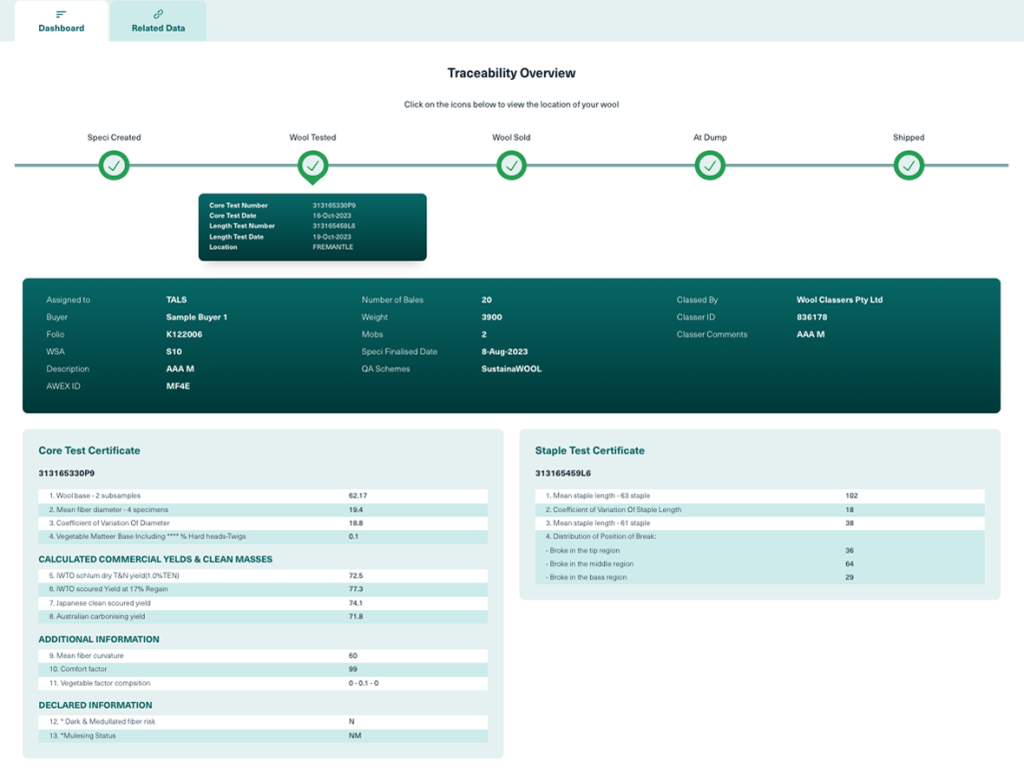
- Providing end-to-end traceability: From farm to processor, each wool bale is digitally tracked using unique eBaleIDs, ensuring visibility of its journey and handling.
- Aligning with AUSVETPLAN: AWTH complements national livestock disease preparedness plans, allowing government and industry to act swiftly and in coordination during an outbreak.
- Centralising traceability data: A single, secure platform ensures that Chief Veterinary Officers can request access to accurate, up-to-date information when it’s needed most, improving response speed and decision-making.
Commercial Traceability
The AWTH delivers robust commercial traceability capabilities by:
- Tracking wool bales end-to-end: Each bale is assigned an eBaleID and linked to a Property Identification Code (PIC), enabling digital tracking from farm to broker, dump, ship, and finally the mill.
- Integrating industry data sources: AWTH pulls information from WoolClip, AWTA, the Data Communications Network, and Export Delivery Orders to create a unified traceability profile for every bale.
- Enhancing transparency: Stakeholders along the supply chain—including growers, brokers, exporters, and processors—can verify bale origin, handling, and quality attributes in a secure environment.
- Facilitating compliance: By supporting certification and audit requirements, AWTH helps stakeholders meet national and international market standards for provenance, quality, and integrity.
- Empowering users with data sharing controls, enabling them to manage who can access their data, opt in or out of specific functions, and request data purges when necessary.
Integrity Scheme Certification
The AWTH supports Integrity Scheme Certification through tools that streamline and automate key compliance workflows:
- AWSS Certification integration: The Hub connects with the Australian Wool Sustainability Scheme (AWSS), allowing users to request Certificates of Compliance for eligible grower lots directly within the AWTH platform.
- Integration with certification bodies: AWTH is developing API connectivity with Control Union, IDFL, and Textile Exchange’s e-Trackit system to automate transaction certificate requests directly from within the platform.
- Grower membership validation: AWTH verifies grower participation in schemes such as AWSS, Authentico, and the Responsible Wool Standard (RWS), ensuring certification claims are backed by data.
- End-to-end data linkage: Bale data, PICs, test results, and delivery records are consolidated to support audit and compliance processes.
- Reduced manual handling: Automated workflows reduce administrative costs and improve timeliness and accuracy in certification management.